![libro "[RESEARCH] Subakaneria: School Journalism as an Act of Resistance, Memory, and Educational Transformation in Public Schoolspara Transformar. Subakaneria, Medios de Comunicación"](/images/editorial-subakaneria/Comunicar_Para_Transformar/PARA-REGISTRO---contraportada-alta-definición.jpg "[RESEARCH] Subakaneria: School Journalism as an Act of Resistance, Memory, and Educational Transformation in Public Schools")
Abstract
Lee la versión en español de esta investigación aquí
This article presents a systematization and critical reflection on the Subakaneria project, a school journalism platform with a thirteen-year history, founded at the I.E.D. Nueva Colombia in the Suba district of Bogotá, Colombia.
Drawing from the book "Comunicar para Transformar. Subakaneria, Medios de Comunicación" (To Communicate to Transform. Subakaneria, Media), written by teacher Gloria Esperanza Huérfano Moreno, the article analyzes the impact of narrative language, educommunication, multiliteracy, and critical pedagogy on the formation of school citizenship. It shows how Subakaneria evolved from a classroom initiative into a replicable model of school media that thinks, transforms, and documents reality from the periphery, generating agency, autonomy, and narrative thinking in students. The text serves as a defense of non-institutionalized school journalism as a space for cultural resistance and collective healing.
Keywords: Educommunication, critical pedagogy, school media, student journalism, narrative citizenship, educational transformation.
1. Introduction
Public schools in Latin America have historically been a space of imposed silences: student voices ignored, peripheral knowledge minimized, and transformative projects relegated to a "pedagogical appendix." In this context, Subakaneria emerged as a disruptive classroom initiative, founded by teacher Gloria Esperanza Huérfano Moreno, which turned words into a tool for educational justice, critical communication, and citizen formation.
The book "Comunicar para Transformar. Subakaneria, Medios de Comunicación" (2025) captures the living memory of this project, its theoretical foundations, its pedagogical outcomes, and its human impact. It is a valuable document not only as a school experience but as an academic model of applied educommunication, language democratization, and technological appropriation in vulnerable contexts.
2. Theoretical Framework: The Word as a Right, the Classroom as a Medium
Inspired by the theories of Paulo Freire, Jesús Martín-Barbero, and Mario Kaplún, the Subakaneria project understands communication not as a transmission but as an encounter; not as a tool but as a right.
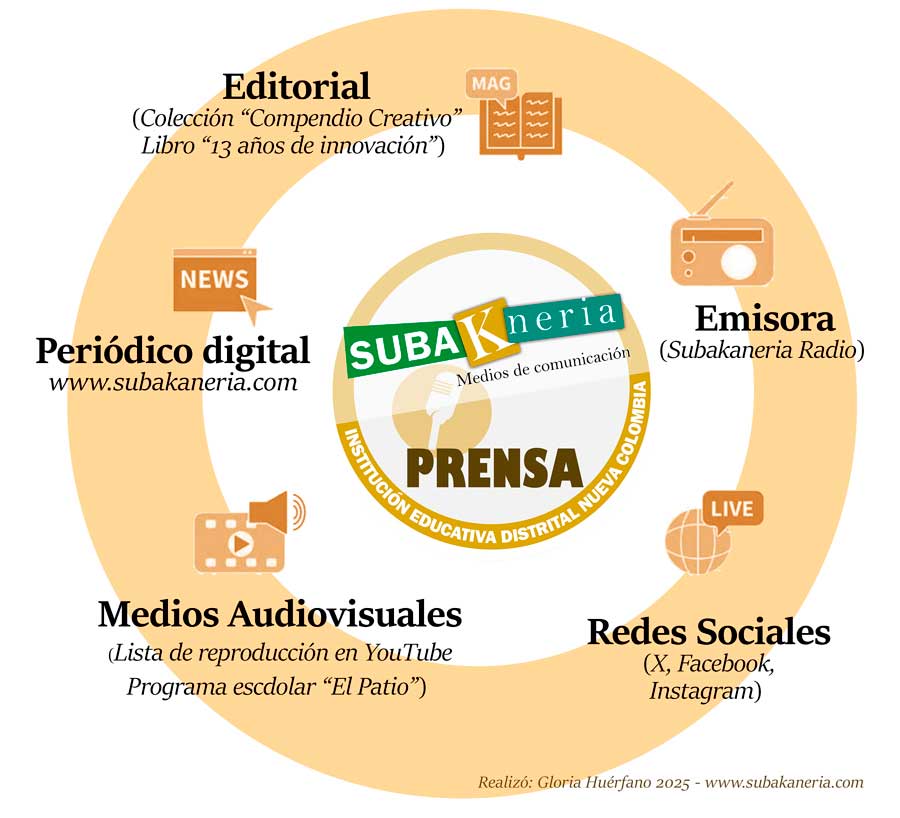
Instead of implementing school media "from above" or as a curricular adornment, a critical, multichannel, and self-managed platform was built where students stopped being passive recipients and became narrators of their own reality. The word ceased to be an instrument of obedience and became a political act of memory, denunciation, healing, and hope.
3. Methodology: Systematization of a Living Experience
The book follows a qualitative, narrative, testimonial, and reflexive systematization methodology. Each section of the text answers a key question in processes of educational innovation:
-
What need gave rise to the project?
-
What transformations did it produce in students, teachers, and the community?
-
How was it organized technically, ethically, and pedagogically?
-
What tensions and resistance did it face within the school system?
-
What lessons can be replicated in other territories?
The author documents thirteen years of school history with rigor and sensitivity, from the first borrowed camera to the consolidation of Subakaneria as an ecosystem of alternative school communication.
4. Results: Learnings, Resistance, and Achievements
4.1 Pedagogical Impact
-
Subakaneria strengthened communication skills, critical thinking, collaborative work, and youth leadership.
-
It became a cross-curricular strategy for reading, writing, and oral expression.
-
It redefined the role of the teacher as a mentor, editor, and emotional guide.
4.2 Community and Emotional Impact
-
Testimonies show that the project became an emotional refuge and a space for healing for students in contexts of violence, exclusion, or family silence.
-
Families saw Subakaneria as an emotional extension of the classroom.
4.3 Institutional and Political Impact
-
Despite bureaucratic resistance, censorship, and internal tensions, the project was recognized locally, at the district level, and nationally.
-
The www.subakaneria.com platform achieved technological sovereignty and its own production of multi-format content.
5. Discussion: Between Institutionalization and Autonomy
One of the key dilemmas addressed in the book is the tension between institutional recognition and the preservation of the project's ethical and critical identity. Subakaneria has resisted attempts at control, symbolic appropriation, and the emptying of its meaning by structures that do not understand its community and narrative roots.
The author argues that words cannot be institutionalized if they lose their transformative meaning, and that the symbolic, pedagogical, and emotional ownership of the project belongs to those who have lived, built, and protected it from within the classroom.
6. Conclusions: Towards a Pedagogy of the Word
"Comunicar para Transformar" is more than a book: it is a declaration of principles. It is living proof that another kind of school is possible if we commit to the word, to voice, to listening, and to memory. Subakaneria demonstrates that school journalism is not a luxury but a democratic necessity, and that educommunication can be the way to humanize learning, make the invisible visible, and transform the school from the inside out.
7. Recommendations for the Educational System
-
Include school media in the PEI (Institutional Educational Project) as a core element of citizen formation.
-
Strengthen critical digital literacy as a right.
-
Recognize the work of teachers in communication projects as legitimate academic work, not as an "additional burden."
-
Promote a national network of school educommunication experiences with a community focus.
References (Suggested Selection)
-
Freire, P. (1970). Pedagogy of the Oppressed.
-
Martín-Barbero, J. (2003). De los medios a las mediaciones (From Media to Mediations).
-
Kaplún, M. (1998). Una pedagogía de la comunicación (A Pedagogy of Communication).
-
Huérfano Moreno, G. E. (2025). Comunicar para Transformar. Subakaneria, Medios de Comunicación (To Communicate to Transform. Subakaneria, Media). Subakaneria Editorial.
-
UNESCO (2022). Educomunicación y ciudadanía digital en contextos escolares (Educommunication and Digital Citizenship in School Contexts).